
Hidden Beneath McKenzie County
Travis Bateman
Farmer Staff Writer
Thousands of feet beneath the rolling prairie and rugged badlands of western North Dakota lies one of the state’s most remarkable geological secrets. Invisible from the surface and unknown to early settlers, the Red Wing Creek Impact Structure is the scar left by a massive meteorite that slammed into the Earth roughly 200 million years ago - an event that forever changed the landscape beneath McKenzie County and, millions of years later, helped create one of the Williston Basin’s most unique oil fields.
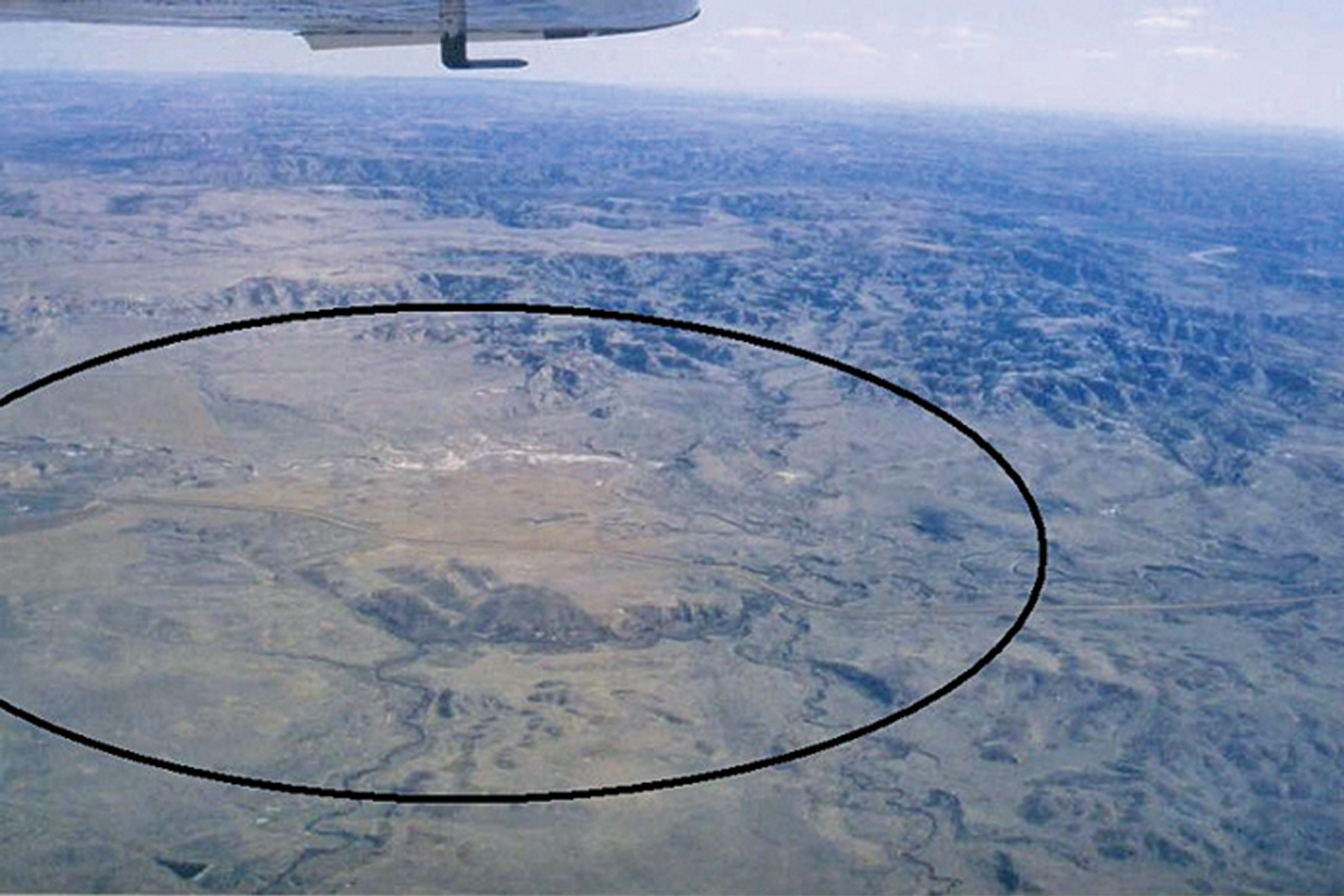
Unlike Arizona’s famous Meteor Crater, visitors can stand directly above the Red Wing structure without ever realizing it exists. There are no towering crater walls, no visitor center, and no obvious geological clues. The impact site is buried beneath nearly 6,500 feet of sedimentary rock, concealed by millions of years of geological history.
Yet beneath that blanket of rock lies one of North America’s confirmed meteor impact craters and a scientific treasure that continues to fascinate geologists around the world.
Catastrophic Collision
Scientists estimate that a large meteorite struck what is now southwestern McKenzie County approximately 200 million years ago during the Late Triassic or Early Jurassic Period.
The collision excavated a crater measuring nearly 5.6 miles across, instantly vaporizing rock at the point of impact while generating temperatures hotter than the surface of the sun and pressures unlike anything produced by ordinary geological processes.
The explosion would have unleashed energy equivalent to millions of nuclear weapons, sending shock waves racing across the ancient landscape, triggering powerful earthquakes, and blasting pulverized rock high into the atmosphere before it rained back to Earth over a wide region.
Although immense by human standards, the impact was far smaller than the asteroid responsible for the extinction of the dinosaurs some 66 million years ago. Dinosaurs had already begun roaming the Earth when the Red Wing meteor struck, making it possible that some of the earliest dinosaurs witnessed the event from hundreds of miles away.
At the time, North Dakota looked dramatically different than it does today. The area formed part of the supercontinent Pangaea, characterized by broad river systems, floodplains, and arid environments rather than the grasslands and badlands now associated with the region.
Unlike many famous impact craters, the Red Wing structure slowly disappeared from view.
Over tens of millions of years, rivers, seas, and changing climates deposited thousands of feet of sediment over the crater. Layer upon layer of sandstone, shale, limestone, and other sedimentary rocks eventually sealed the impact beneath the surface, erasing any visible evidence.
Today, the crater cannot be identified from the air or on the ground.
Instead, scientists have mapped it using seismic reflection surveys, gravity measurements, magnetic data, and deep drilling performed during oil exploration throughout the Williston Basin.
These studies reveal the classic features of a complex impact crater, including a raised central uplift, a surrounding ring-shaped depression, and an outer rim - all preserved beneath the Earth’s surface.
Oil Exploration
Unlocks Mystery
Ironically, the Red Wing crater was not discovered by scientists searching for meteorites, but by petroleum geologists searching for oil.
During the 1960s, seismic surveys revealed an unusual circular structure deep underground. At first, geologists debated its origin. Some believed it might have been created by volcanic activity, salt movement, or tectonic uplift.
Everything changed when drilling penetrated the disturbed rocks.
Core samples revealed fractured limestone and dolomite unlike anything normally encountered in the Williston Basin. Even more importantly, scientists discovered shocked quartz, shatter cones, impact breccias, and microscopic planar deformation features - mineral signatures that can only form during an extraterrestrial impact.
Those discoveries confirmed that the Red Wing structure had been created by a meteorite traveling at hypervelocity.
The impact had also dramatically altered the underground geology.
The tremendous force fractured otherwise tight reservoir rocks and created traps where petroleum accumulated over millions of years. Rather than the relatively thin oil columns commonly found elsewhere in the basin, the Red Wing field contained an extraordinarily thick column of oil approaching 2,850 feet.
The field became one of the world’s best-known examples of petroleum production from an ancient meteor impact structure and helped geologists better understand how impact craters can become highly productive hydrocarbon reservoirs.
Today, the Red Wing Creek Impact Structure is recognized in the international Earth Impact Database as one of Earth’s confirmed meteor impact sites.
Researchers continue studying the buried crater because it offers valuable insight into impact crater formation, shock metamorphism, petroleum geology, and the geological evolution of the Williston Basin.
For residents of McKenzie County, however, the crater remains an invisible landmark.
Travelers driving county roads southwest of Watford City pass over it every day without realizing they are crossing the remnants of an ancient cosmic collision.
Unlike Theodore Roosevelt National Park or the Little Missouri Badlands, the Red Wing crater cannot be photographed from a scenic overlook or explored on foot. Its story exists beneath the surface, preserved in rock layers that record a moment when Earth collided with an object from space.
The Red Wing Creek Impact Structure serves as a reminder that McKenzie County’s history extends far beyond the oil boom, ranching heritage, or the arrival of modern communities.
Long before humans walked the Northern Plains, before the Rocky Mountains reached their present form, and before the dinosaurs disappeared, a meteorite forever altered the geology beneath western North Dakota.
Millions of years later, that violent event would unknowingly help create one of the region’s most unusual oil fields and provide scientists with an extraordinary natural laboratory hidden beneath the prairie.
Although invisible to the eye, the Red Wing crater remains one of McKenzie County’s greatest geological wonders - a buried monument to one of the most powerful forces in the history of our planet