
Virtual Fencing Meets Conservation: North Dakota Wildlife Federation Helps Badlands Ranching While Enhancing Wildlife Habitat
Travis Bateman
Farmer Staff Writer
A relatively new technology is beginning to reshape the conversation surrounding livestock management, wildlife conservation, and public land stewardship in western North Dakota. Known as virtual fencing, the GPS-based system is allowing ranchers to manage cattle without relying solely on miles of traditional barbed wire, while conservation organizations see an opportunity to improve wildlife habitat, reduce conflicts, and preserve public access across the Badlands.
The latest example is taking place in the rugged country surrounding Grassy Butte, where the North Dakota Wildlife Federation is partnering with local rancher Lee Geiger to help implement virtual fencing on thousands of acres bordering Theodore Roosevelt National Park and the Dakota Prairie Grasslands.
While the technology is designed primarily to improve livestock management, conservation leaders believe the benefits extend well beyond cattle production.
Conservation Through
Better Grazing
The North Dakota Wildlife Federation has advocated for wildlife, habitat, and public access since 1935. Its mission focuses on conserving wildlife habitat while supporting hunting, fishing, trapping, bird watching, and other outdoor recreation opportunities across the state.
According to Cara Greger, Western Conservation Director for the Federation, the organization’s investment in virtual fencing stems directly from that mission.
Greger became the Federation’s first western North Dakota habitat employee in April 2023. Her position was created using funding from the Holmes Estate specifically to support habitat improvement projects in McKenzie and Dunn counties, where much of North Dakota’s most valuable wildlife habitat exists on working ranches.
“Our goal is keeping habitat on the ground,” Greger explained. “Western North Dakota is unique because public lands used by hunters and outdoor recreationists also support working ranches. Healthy grazing management helps maintain those landscapes for everyone.”
Much of western North Dakota consists of privately owned rangeland intermixed with federal and state lands. Because ranching operations often encompass all three ownership types, successful habitat conservation frequently depends upon cooperation between landowners, conservation groups, and government agencies.
Why Virtual Fence?
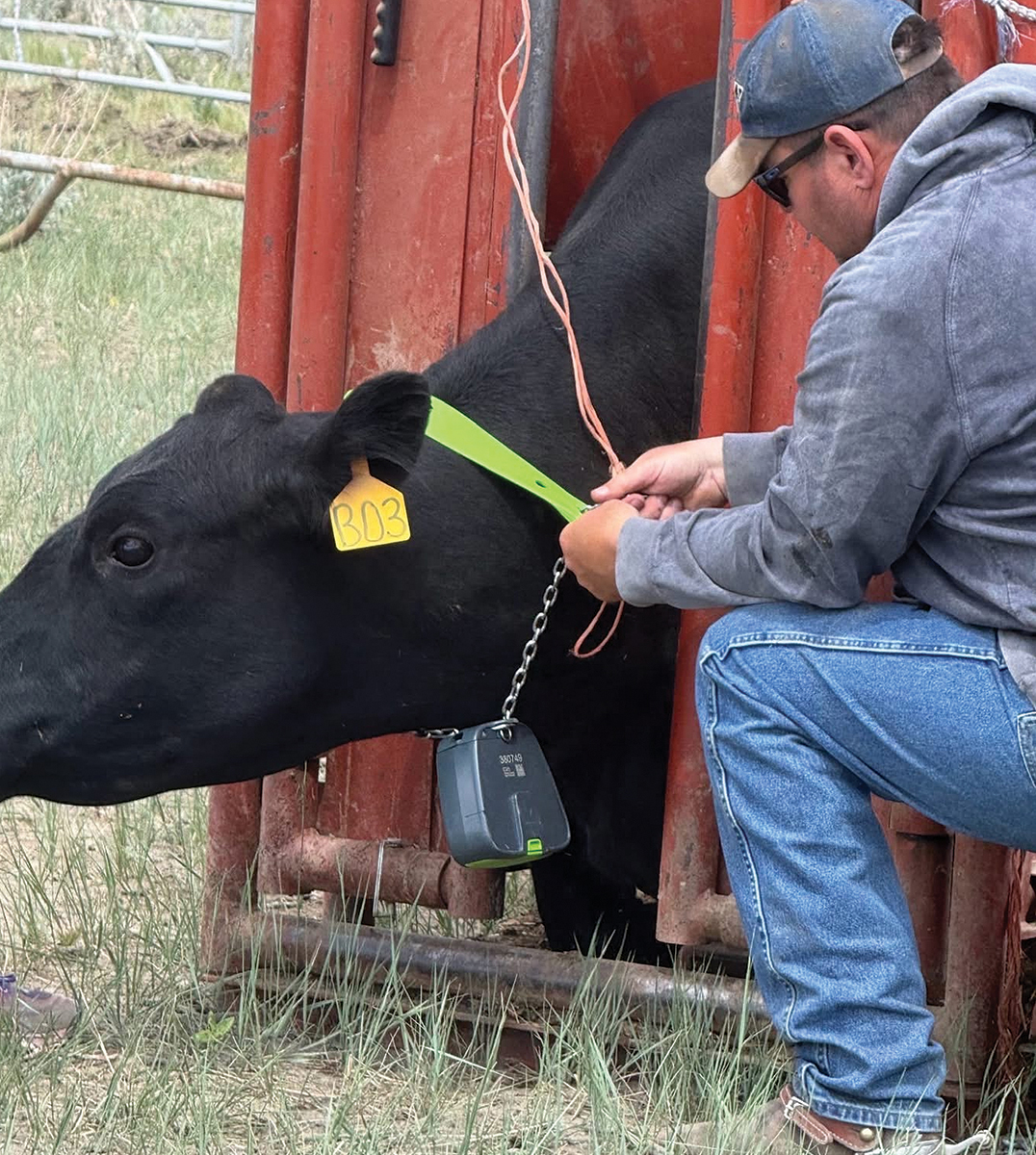
Virtual fencing replaces many interior physical fences with GPS-enabled collars worn by cattle.
Instead of encountering a physical fence, livestock receive audio warnings followed by mild electronic stimulation when approaching digitally drawn boundaries. Over time, cattle learn where invisible boundaries exist, allowing ranchers to move grazing areas remotely through computer or smartphone software without building additional cross fencing. Research by North Dakota State University has shown the technology can provide grazing control comparable to traditional fencing in many applications while greatly increasing management flexibility.
For ranchers operating in the steep, broken terrain of the North Dakota Badlands, that flexibility can be especially valuable.
Lee and Bobbi Geiger have operated their Grassy Butte-area ranch since 2008, raising Angus cattle alongside horses, goats and chickens.
Their grazing operation includes approximately:
• 3,000 acres of U.S. Forest Service grazing allotments
• 640 acres of North Dakota State Trust lands
• 2,560 acres of privately owned pasture
Much of that country consists of rugged breaks, deep draws, river bottoms and difficult terrain where building and maintaining conventional fence is expensive and often impractical.
Bordering Theodore Roosevelt National Park
One of the Geiger ranch’s most unique characteristics is its location.
The family’s U.S. Forest Service grazing allotment borders Theodore Roosevelt National Park’s North Unit, with the Little Missouri River serving as much of the boundary.
Changing river conditions, flooding and difficult terrain can make maintaining physical fences challenging. Virtual fencing offers an additional management tool that could help keep cattle out of the national park while reducing the need for extensive permanent fencing.
The technology also allows grazing boundaries to be adjusted quickly as conditions change.
Improving Wildlife Habitat
Conservation organizations increasingly view virtual fencing as more than simply a ranch management tool.
Proper rotational grazing has long been recognized as an important component of maintaining healthy prairie ecosystems. Native grasslands evolved alongside grazing animals and periodic fire, with carefully managed grazing helping create varying vegetation heights and improving plant diversity.
Greger said the Federation became interested after learning how virtual fencing could improve rotational grazing while reducing physical barriers across wildlife habitat.
For wildlife, fewer permanent fences can mean safer movement across the landscape.
Traditional fencing can impede migration, injure deer, pronghorn and elk, and create obstacles for numerous wildlife species. Conservation groups across the western United States increasingly recognize wildlife-friendly fencing - or reducing unnecessary fencing altogether - as an important habitat improvement strategy.
The Geiger ranch regularly supports a wide variety of wildlife including: Mule deer; White-tailed deer; Pronghorn; Elk; Bighorn sheep; Sharp-tailed grouse; Gray partridge; Wild turkey; Mountain lions; Coyotes.
Additional water developments planned as part of improved grazing distribution will also provide wildlife with additional dependable water sources while helping distribute livestock more evenly across pastures.
Better grazing management also reduces prolonged cattle use of riparian areas, helping protect water quality and sensitive streamside vegetation.
Helping Public Lands
Unlike many ranches operating solely on private property, a significant portion of the Geiger grazing operation occurs on lands already open to the public.
Approximately half of the acreage grazed is U.S. Forest Service or State Trust land that remains available for public hunting.
Greger said that public benefit played a significant role in the Federation’s decision to help fund the project.
Because Federation members hunt, hike, camp and recreate throughout the Badlands, improving habitat on these landscapes aligns directly with the organization’s mission.
The Maah Daah Hey Trail also traverses portions of the grazing allotment.
During periods of heavy trail use or special events, virtual fencing would allow livestock boundaries to be temporarily adjusted to reduce encounters between trail users and cattle without requiring construction or removal of temporary fencing.
Winter Grazing Improvements
Lee and Bobbi Geiger also hope virtual fencing improves another important management practice - winter bale grazing.
Rather than feeding cattle in confined areas, bale grazing distributes feed across hayfields during winter months.
As cattle consume hay and naturally distribute manure and nutrients across the field, soil fertility can improve significantly.
The Geigers say they have already observed increased hay production using improved distribution methods and believe virtual fencing could make those systems even more effective.
Financial Hurdles
Despite its promise, virtual fencing remains expensive.
GPS collars represent a significant upfront investment, especially for family-owned ranches managing large herds.
Lee Geiger has researched the technology for approximately three years but delayed implementation because of its cost and uncertainty about how well it would perform in Badlands terrain.
The North Dakota Wildlife Federation is helping bridge that gap through a 10 percent cost-share using Holmes Estate funding.
Greger said additional financial assistance may also be available through several conservation organizations and agencies, including: Ducks Unlimited; Pheasants Forever; Rocky Mountain Elk Foundation; National Wild Turkey Federation; Mule Deer Foundation; USDA Natural Resources Conservation Service offices in Watford City and Killdeer.
Many organizations recognize that healthier grazing systems frequently produce benefits extending well beyond agricultural production.
Beyond Virtual Fence
Although virtual fencing has received considerable attention, it represents only one portion of the Federation’s growing conservation efforts.
Greger’s western North Dakota program also supports:
• Wildlife-friendly fence replacement
• Native grass and forb establishment
• Water developments
• Woody encroachment removal, including Russian olive, Siberian elm and Rocky Mountain juniper
• Prescribed burning projects on private lands throughout North Dakota when funding is available
The Federation expanded those efforts further in January 2026 by hiring a second habitat specialist based in Mayville to work with eastern North Dakota landowners.
Balancing Ranching
and Recreation
Greger says the project illustrates that wildlife conservation and livestock production are not mutually exclusive.
Instead, successful conservation increasingly depends upon partnerships with the ranchers who manage much of North Dakota’s remaining native prairie.
For Geiger, the project represents an opportunity to improve grazing management while continuing a long tradition of supporting responsible public access.
Although not enrolled in North Dakota’s Private Land Open To Sportsmen (PLOTS) program, Geiger allows hunting by permission on his private lands and notes that approximately a dozen hunters request access each year. He has also supported youth hunting by providing opportunities for local young hunters, while much of the federal and state land within his grazing operation remains open to the public.
As virtual fencing technology continues gaining acceptance, projects such as this one may provide a model for how emerging technology can help ranchers, wildlife managers, public agencies, and outdoor recreationists achieve many of the same conservation goals across North Dakota’s iconic Badlands.