
McKenzie County Endorses Federal Bill Aimed at Easing Yellowstone Fish Bypass Costs for Irrigators
Travis Bateman
Special to The Farmer
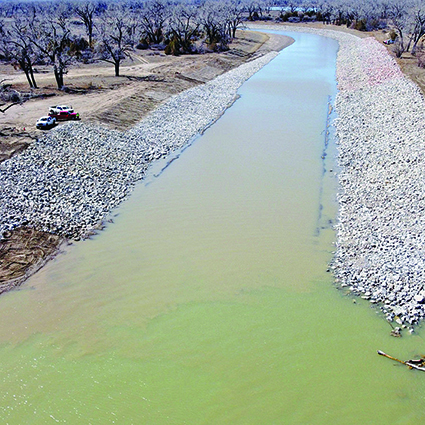
The McKenzie County Commission has formally endorsed federal legislation aimed at keeping local farmers and communities from bearing the cost of maintaining the Lower Yellowstone River fish bypass channel.
In a letter submitted to Congress, the commission voiced support for the Lower Yellowstone River Fish Conservation Act - Senate Bill (SB) 3409 and House Resolution (HR) 6568 - which would reaffirm that the federal government is solely responsible for operating and maintaining the bypass channel built to protect the endangered pallid sturgeon.
The fish bypass channel was authorized in 2007 and constructed by the Bureau of Reclamation outside the boundaries of the Lower Yellowstone Irrigation Project (LYIP). While the structure helps mitigate harm to the pallid sturgeon, winter ice and spring runoff routinely cause significant damage to the bypass, resulting in costly repairs.
Under current arrangements, LYIP irrigators repay the federal government for repairs to irrigation infrastructure. However, project leaders argue that the bypass channel’s damage stems from federal conservation obligations - not irrigation operations - and that local users should not be responsible for those costs.
HR 6568 would clarify that the Bureau of Reclamation retains exclusive ownership, operational control and financial responsibility for the fish bypass channel, shielding LYIP and local governments from future repair bills.
The LYIP supplies irrigation water to most of the Yellowstone River Valley east of Fairview, Montana, including northwestern McKenzie County. The system also plays a critical role in maintaining groundwater levels that supply drinking water to communities from Savage, Montana, to Sidney and Fairview.
In its letter, the McKenzie County Commission warned that shutting down or financially destabilizing the irrigation system could have catastrophic consequences for both agriculture and drinking water supplies throughout the valley.
Approximately 400 farmers could see their irrigation costs double if responsibility for maintaining the fish bypass channel is shifted to local users, according to LYIP officials.
The legislation was introduced by Rep. Troy Downing and Sen. Steve Daines, both of Montana, who say the bill protects irrigators while ensuring the continued recovery of the pallid sturgeon.
“This bill provides a common-sense solution to what should be a common-sense issue on the Lower Yellowstone River,” Downing said in a press release. “It’s good for irrigators, good for taxpayers, good for the sturgeon, and ensures long-term operational and financial stability for the Lower Yellowstone Fish Bypass Channel in eastern Montana. I’m proud to have such a great partner in Senator Daines to champion this legislation and look forward to getting it across the finish line.”
Daines echoed those concerns, emphasizing the burden on rural communities.
“Montana’s local communities should not be unfairly burdened by costly federal projects,” Daines said. “I’m thrilled to work alongside Representative Downing to introduce the Lower Yellowstone River Native Fish Conservation Act, which will help protect Montana’s endangered species and provide essential operational and financial stability for the Lower Yellowstone fish bypass channel.”
LYIP Manager James Brower testified before Congress on Feb. 4, urging lawmakers to ensure the federal government continues to cover the bypass’s maintenance costs.
“It won’t be that it could bankrupt us - it is that it would bankrupt us,” Brower said. “If we are required by an endangered species law interpretation to pay for the maintenance of a very expensive endangered species project that we never agreed to maintain.”
If passed, the legislation would leave ownership, financial responsibility and operational control of the fish bypass channel with the Bureau of Reclamation, rather than shifting those costs to local irrigators and taxpayers.
The bill is currently under consideration in the House Subcommittee on Water, Wildlife, and Fisheries. It must pass both the House and Senate and be signed by the president before becoming law.
The legislation can be tracked online at congress.gov: https://www.congress.gov/bill/119th-congress/house-bill/6568/text.
Subscribe Today For Less Than $1/Week at www.watfordcitynd.com